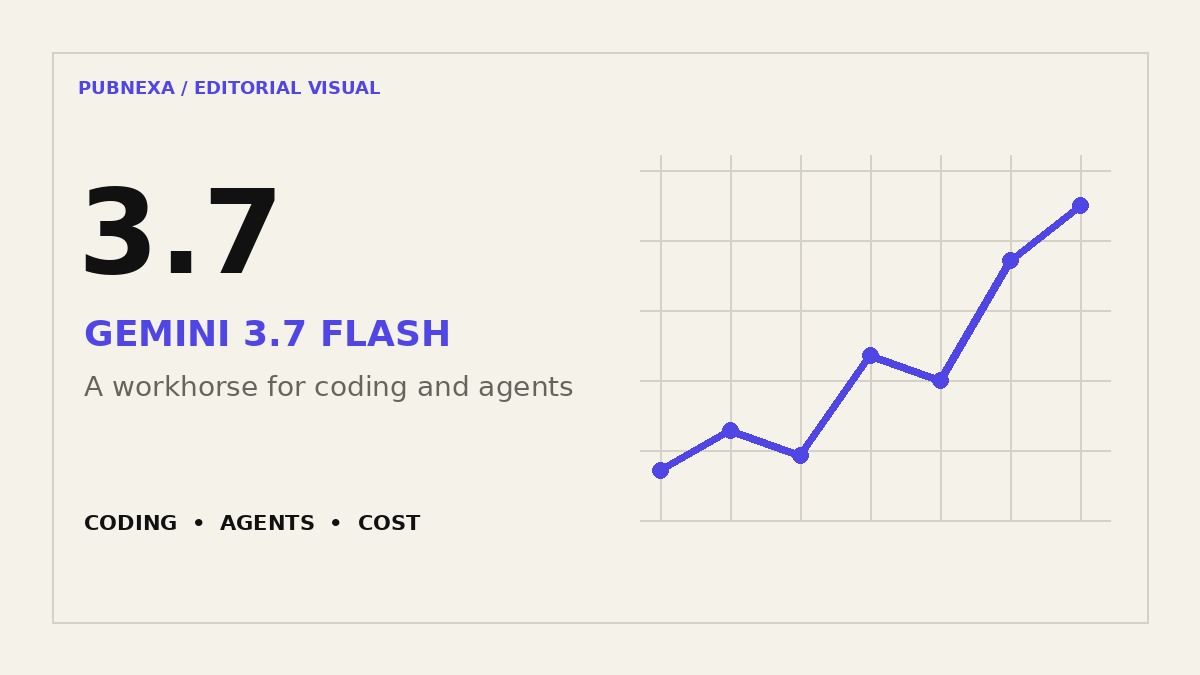
Google has launched Gemini 3.7 Flash, the latest model in its fast-moving Flash family, with a sharper focus on software engineering, autonomous agents and complex business workflows.
The release arrives only three weeks after Gemini 3.6 Flash. Google describes the new model as its most capable “workhorse” model yet for coding and agents, positioning it as a model developers can use for production workloads that require repeated tool use, multi-step planning and fast iteration.
Google says 3.7 Flash improves on its predecessor in debugging, issue resolution, production code generation and web development. The company also says the model follows instructions more reliably and handles roadblocks with less manual intervention during longer workflows.
The company is pairing those improvements with aggressive introductory pricing. Through the end of 2026, Gemini 3.7 Flash costs $0.75 per million input tokens and $3.75 per million output tokens. Google says that is half the original per-token price of Gemini 3.6 Flash.
The pricing matters because agent systems rarely make a single model call. A production agent may repeatedly read documents, invoke tools, inspect results and revise its plan before completing a task. Lower per-token costs can therefore compound across an entire workflow rather than simply making an individual response cheaper.
Google is also moving Gemini Spark, its persistent personal-agent product, to 3.7 Flash. Spark can work across tasks such as organizing files, drafting emails and updating documents, giving Google another route to test the model in longer-running agent workflows outside the developer API.
The launch reinforces how quickly the competitive frontier is shifting from standalone chatbot quality toward the combination of capability, latency, tool use and operating cost. For developers choosing a model for an agent, the question is increasingly not only which system can produce the best answer, but which can reliably complete a chain of actions at a sustainable cost.