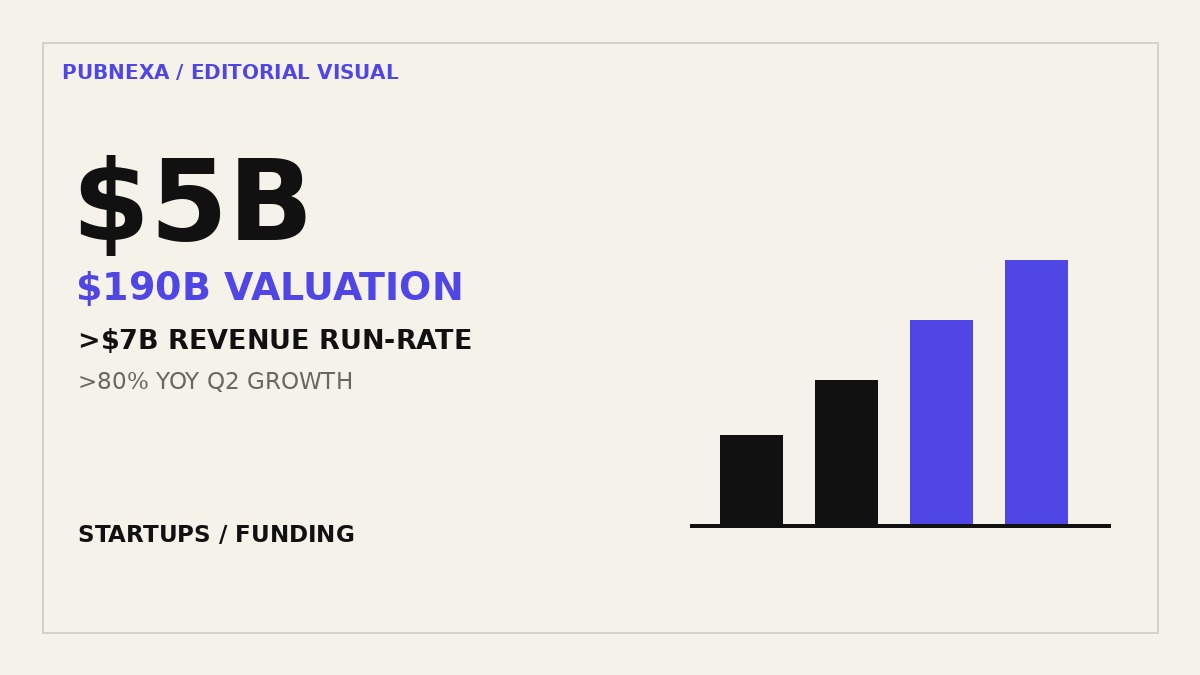
Databricks has closed a $5 billion funding round at a $190 billion valuation, adding another large pool of private capital to one of the most valuable companies in enterprise AI infrastructure.
The company announced the financing on August 13 alongside new operating metrics. Databricks says it has passed a $7 billion annualized revenue run-rate, with revenue growing more than 80% year over year during its second quarter, and that it remained positive on an adjusted free-cash-flow basis over the previous 12 months.
Coatue led the round alongside Blackstone, MGX and accounts advised by T. Rowe Price, while Sixth Street Growth joined as a new investor. Databricks also listed a broader group of new and existing investors participating in the financing.
Reuters independently confirmed the $5 billion round, the $190 billion valuation and the company’s reported revenue run-rate. The new valuation represents another step up for Databricks after a financing earlier in 2026 valued the company at about $134 billion.
Databricks says the new capital will be directed toward products aimed at companies building and operating AI systems on enterprise data. Those include Lakebase, its serverless Postgres database for applications and agents; Genie, an AI assistant designed to work with business data; and Unity AI Gateway, which provides governance, routing and cost controls across AI models.
The company is increasingly presenting the data layer and the agent layer as one market. AI agents need access to operational data, governed context and model infrastructure, and Databricks is betting that enterprises will prefer to manage those components from a unified platform rather than assemble them independently.
The scale of the round also illustrates how concentrated private-market AI investment has become. A $190 billion valuation places Databricks far beyond normal late-stage startup economics and increases the importance of sustained revenue growth, product expansion and eventual liquidity options as investors look for returns on increasingly large checks.